Ritual & Epiphany in the Mysteries of Mithras is one of the most delightfully surprising reads of the year. Not because I have come to expect anything other than erudition from Peter Mark Adams (The Game of Saturn), but because those expectations were entirely eclipsed.
It is not just about the Mysteries of Mithras, it is a beautiful example of the process of cross-referencing ancient accounts of what certain philosophers said about rites, mysteries, epiphanies, and theurgic practices in parallel with contemporary ethnographic accounts of living spiritual traditions… and using each to illuminate the other.
It is a methodology I have been using in my own research for years, this ‘ethnographic cross-referencing’, because of my own lived experiences and searching out references in both ancient and contemporary accounts that illuminate them.
As such, I appreciate the effort and obvious passion put into this work.
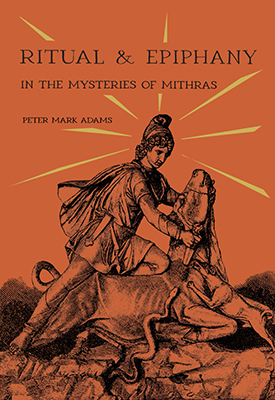
As what I believe will be considered the ‘Opus’ for the ‘Cult of Mithras’ as pertains to practical theurgy, it offers a great many insights into other important aspects of initiatory transmission.
The edition I have (fine hardcover) is limited to only 888 copies, and I have no idea if there will be other printings. You can purchase one directly from Theion Publishing.
Anthologies are curated excerpts from texts I have in my library (Ex Libris) that are part of my ongoing personal research process which focuses heavily on practical aspects of theurgy and the illuminatory process of initiatory traditions in the Divine Mysteries.
I share them (protectively) to provide transparency to my students and subscribers for references I use in my work and to encourage those keenly interested to purchase the full text in support of the authors and publishers.
(I am not receiving commission from the publisher.)
For those that have been with me for a while, and are familiar with how I refer to ‘quickenings’ and ‘crystallizations’ from practicing Illuminatory Seership as a prerequisite of our particular Initiatory Theurgy process, part of these quotes should jump off the page; however, for those who are new I have bolded them.
From the Text, Ritual & Epiphany in the Mysteries of Mithras…
The presencing of divinity is foreshadowed by a distinct change in the field of the ritual space, or spatium, which becomes intensified and ‘electric’. This gives rise to changes in the ritualist’s field of awareness, in which time seems to stand still and mundane details fade, giving way to a defocused but more psycho-physically charged state accompanied by strong sensations of internal energy. (p. 124)
Finally, under conditions of extremely high energy, the initiate experiences an ecstatic, visionary encounter with a deity who may appear in a variety of forms, but whose essential nature remains ineffable: In all the initiations the gods appear in many different forms, in a variety of shapes and sometimes as a formless light; sometimes this light takes a human form and sometimes it appears as something else. (p. 124)
Whilst recent research on theurgy acknowledges the importance of the subtle-body in Neoplatonic discourse; the logical corollary of this – the acknowledgement of the central importance of the serpent power to these practices – is rarely addressed; and when it is, it is subject to major issues of interpretation. (p. 202)
Full access to Ex Libris (Anthologies) posts is restricted to logged in users with an active Aethyrworld Membership.
Excerpts Continued:
Excerpted from:
Adams, Peter Mark, Ritual & Epiphany in the Mysteries of Mithras, Theion Publishing, 2025